
From Intern to Senior Principal: Naveen Waney Reflects on 40 Years at Platt/Whitelaw Architects
In Platt/Whitelaw Architects’ 70th anniversary year, it’s notable that one team member has worked at the firm for more than half its lifetime! Naveen Waney joined our firm in 1985 and worked his way up from intern (gopher) to owner and senior principal.
As part of our principal profile series, we sat down with Naveen to reflect on Platt/Whitelaw’s legacy and to think about its future.
Q: How has the firm evolved since you joined the leadership team?
A: We’ve consistently focused on community-serving architecture, but I’ve worked to diversify our project types. Our bread-and-butter categories have shifted a bit, too. We have a lot of experience designing for schools and we love that work, but now our work with water and wastewater treatment facilities represents the largest share of our product types. It’s important and plentiful work in Southern California, where prudent water management is critical.
I feel like our firm has also become more prominent in our industry. On several occasions, I’ve heard us called a leading firm for some of our specialties, and I love hearing from others that we’re considered the “go-to architecture firm” for water and wastewater projects.
Q: What do you enjoy most about leading the firm?
A: I like to have a direct, positive impact on people. I provide the leadership necessary for our staff to have supportive, professionally rewarding and meaningful career experiences. I also enjoy mentoring our staff so that they, too, can rise through the firm’s ranks, and that we have a solid talent base and work culture for our future. Being an owner and senior principal of Platt/Whitelaw Architects brings me a lot of pride. I was raised to work hard toward a goal, and I feel like I’ve earned my place in our firm and our industry.
Q: How would you describe the dynamic between the Platt/Whitelaw leadership team?
A: Our team of principals, who also include Thomas Brothers and Peter Soutowood, have earned their stripes. All three of us have acquired diverse, well-honed skills, and we operate without ego. We’ve all worked together for a long time, and we understand each other. We always try to resolve issues with unanimous agreement because we respect each other’s feelings and opinions. And, when Thomas and Peter defer to me as the senior principal, it’s because they know I have put in the time and always put our firm and its staff first.
Q: What are you looking forward to about Platt/Whitelaw Architects’ future?
A: I know we will continue our firm’s legacy and its growth by being good at what we do and by investing in the tools and education that will keep us on the cutting edge of continuous improvement. I also like that many of our staff have opened doors for us in areas that interest them. Thomas co-chairs American Institute of Architecture (AIA) San Diego Chapter’s Committee on the Environment (COTE) and wants to take our sustainable architecture work, for which we’ve long been known, to the next level. Peter wants to elevate the technical problem-solving design work we take on. All three of us encourage and empower the rest of our staff to explore different avenues, too.
Q: What were some of your favorite projects to design at Platt/Whitelaw?
A: I really love the water and wastewater industry. I find it fascinating. I learned a lot on one of my first projects in this sector: The Encina Wastewater Authority Facility in Carlsbad, California. Working with multiple agency stakeholders in developing an Operations and Maintenance building, you learn how to manage everyone’s needs to bring together a successful project. Designing for the North Pacific Beach Lifeguard Station taught me a lot, too. We solved a lot of the City of San Diego’s challenges on that project, and each challenge was its own small design project that had to come together with all the others as a cohesive whole.
Currently, designing a Hindu temple in Escondido, California for ISKCON is feeding my soul, maybe in more ways than one. I’m an Indian-American architect and lived in India until I was nine years old. I was surrounded by Hindu temples and by other buildings that took architectural cues from them. I used to look at temples as a place to worship, and now I’m looking at all the different ways people interact with them. It’s a full-circle moment to bring that aesthetic experience to my home in San Diego while gaining a deeper understanding of how to create a sense of enlightenment and inspiration.
Q: What’s a project that scared you a little at the start—but ended up teaching you the most?
A: There’s a systematic method to architecture, so designing a project doesn’t scare me, but I will say that school architecture, especially K-12 modernization work, is tricky. You must understand the design program, the needs of every teacher and administrator and how they’re associated with each other and with the school’s different functions. You must fit that big puzzle together and make it work while also making sure the school can remain operational during the modernization work. Designing for school modernization teaches you how to listen, manage expectations and amalgamate a lot of priorities into a design.
Q: What made you want to become an architect?
A: I didn’t grow up knowing what I wanted to do. I was reasonably good at drawing and computers in high school, but I chose my college, Cal State Fullerton, because I was invited to play soccer there. At Mesa College, after soccer didn’t pan out, I remembered that I was good at drawing and putting things together with a lot of attention to detail. I entered a “lumberman’s” drawing competition, where you had to hand-draw a housing complex that could be made of wood, and I won. After that, with my scholarship money, I enrolled at NewSchool of Architecture & Design, where I would graduate as their first Valedictorian. Turns out, I have the mind of an architect.
Q: What’s the first building or space that was significant in your career?
A: I will always remember the first site visit our previous firm owner, Alison Whitelaw, and I did to inform our design for the City of San Diego Alvarado Water Filtration Plant, a public works project. We stepped inside the beautiful, old building, where an engineer took us over to a nondescript hatch in the floor. When he opened it, we saw millions of gallons of water flowing under the building into a reservoir. It was fascinating how this entire plant was operating behind the scenes, unknown to passersby. This unknown powerful sense of space just lit me up and drove me toward wanting to find out more about this sector.
Q: What’s your best piece of advice for someone considering an architecture career?
A: It’s an art with its own technique. When you design a space, you need to understand what you’re doing, what you’re putting together and how it affects the community and the world around it. It’s easy to get lost in the details and forget why the project is there in the first place. After your first design, take time to step back and consider what you’ve created. Go back and forth between those micro and macro mindsets, which might mean dismantling your first design and putting it back together with new refinements. Always ask yourself: How does what you are proposing affect the environment? Will it do justice to the world you live in?
Also, be open to learning about the architectural tools and methods of the past. Your knowledge base will be more sophisticated and comprehensive for it.
Q: How has your family supported your career?
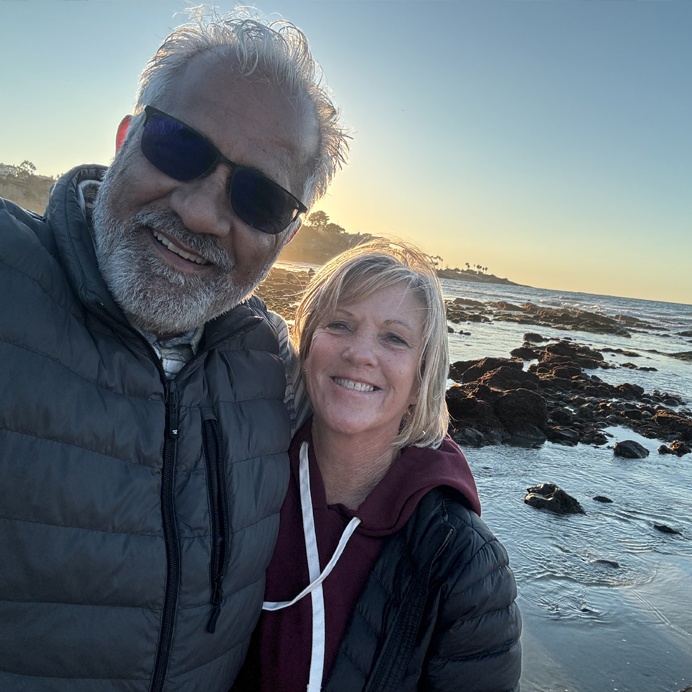
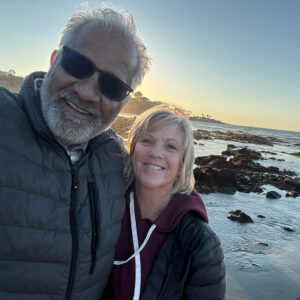
A: My wife Michelle and my kids, Justin and Jennae, mean everything to me. Michelle has been a pillar of support throughout my career, starting from my college years. Yes, we met when we were teenagers! She and the kids were united in their patience and supported me while I grew my career. It’s wonderful for me and Michelle to be in a place where we’re enjoying the fruits of our labor and seeing the kids start building their own lives (Justin married Lauren) and careers (Jennae is a veterinarian). I’m confident that they’ve learned an amazing work ethic and how to live their lives from us.
Rapid-Fire Fun Questions
- Do you prefer coffee or tea?
- Masala chai tea
- What’s a destination high on your travel bucket list?
- Thailand, Phuket
- What’s your favorite restaurant in Old Town, where your firm is located?
- El Agave
- What’s your favorite place to visit in San Diego?
- Anywhere on the beach boardwalk
- What’s your favorite piece of architecture that Platt/Whitelaw Architects designed?
- Encina Wastewater Treatment Plant. It’s fun to still see my architectural influence there.
- What’s your favorite piece of architecture in San Diego that Platt/Whitelaw Architects didn’t design?
- The Salk Institute. I think the architectural volumes and its dramatic setting are stunning.
- What’s one talent you have other than architecture?
- I’m a good (a bit seasoned now) soccer player