
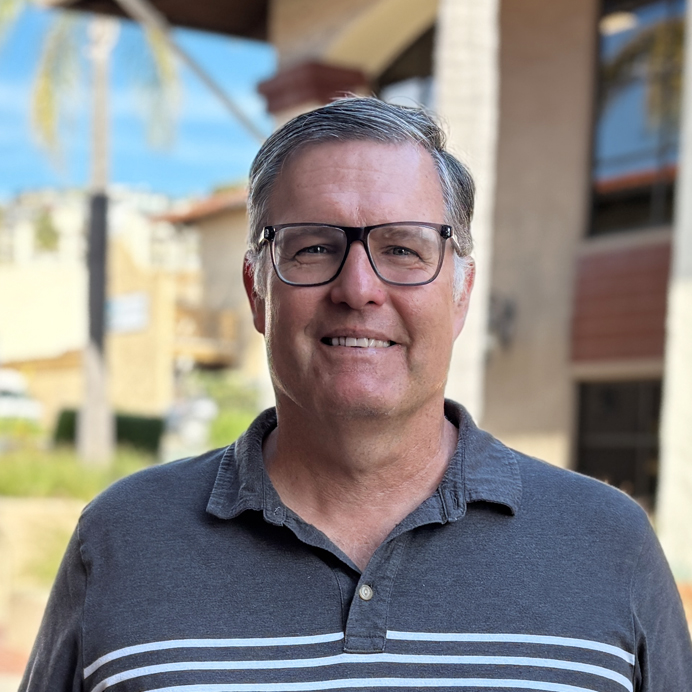
Associate Architect Dave Madigan on Community Projects, Sustainable Design and His 14-Year Journey at Platt/Whitelaw Architects
Article Summary: Registered architect Dave Madigan reflects on his 14-year journey with Platt/Whitelaw Architects, sharing why he returned to the firm, how its commitment to sustainable, community-focused design has evolved and what he values most about its collaborative culture. From municipal and water infrastructure projects to historic renovations and the El Centro Aquatic Center, Dave highlights the importance of architecture that serves the public, stands the test of time and gives back to the community.
After profiling our three principals – see Naveen’s, Peter’s and Thomas’s profiles – we’re turning the spotlight on our associate, registered architect Dave Madigan.
Dave has worked with Platt/Whitelaw Architects for 14 years, eight of those as an associate. His career path wasn’t a straight line, though. Read on to learn about why Dave returned to Platt/Whitelaw, how he first planned to be an aerospace engineer and the things he likes most about his job.
Q: Why did you return to Platt/Whitelaw Architects, and why do you think so many other people have, too?
A: When I left Platt/Whitelaw, I went to work at a firm that designed for restaurant and technology clients. They typically wanted fun, trendy designs that would need to be reworked and remodeled every few years. It was enjoyable to work with creative clients who welcomed unique ideas, but I appreciate being back at Platt/Whitelaw where design matters, but we’re also focused on creating buildings that stand the test of time and give back to the community.
I also came back because I like the atmosphere here. We work hard, but our management team is realistic about what everyone can accomplish in the allotted time.
I really appreciate that the work we do helps communities and that I have good people to work with. Design is important here, but we don’t have a signature design style that we have to stick to since we design to suit the user. There’s space for our people to contribute their own ideas, and that’s a big plus for me.
Q: How has Platt/Whitelaw Architects evolved since you’ve been here?
A: While we still work on a lot of the same types of projects as before, we’ve added new categories over the last decade or so. We still do a lot of work with school districts, but projects for municipalities and water and wastewater agencies have diversified our projects roster.
As one of the architecture firms that embraced sustainable design very early – and even designed the first project in the United States to earn the Energy Star Label – I think our expansion into water projects makes a lot of sense. Helping to secure the water supply is a pillar of sustainability for the Southern California region.
Q: What’s something you enjoy most about your job?
A: Many of our municipal projects include community meetings where residents weigh in about what they want from the planned project. I really enjoy this process. I enjoy the exchange of information between the designer and the end users. It’s a great way for us to hear different ideas and to grow as architects.
Q: How would you characterize the culture in the Platt/Whitelaw office?
A: Our office is full of good, friendly people who take their work seriously. We have a culture of trust where people can work somewhat independently, but we also have an excellent oversight system for quality control. Sometimes, I run with a project like it’s my own, but I know I have back up. Other times, I’m part of a design team for a large project, collaborating with a half dozen other designers. I appreciate this balance.
Q: What are you looking forward to about the future of the firm?
A: I hope we continue to expand into other areas to further diversify our portfolio of work. I also like that we have some young, new principals who contribute a different perspective, but also very much respect our more experienced leaders. I think it’s a strength that our former principals and owners — Alison Whitelaw and Sandra Gramley — still make themselves available for advice and that our current principals value that input.
Q: What is the first building or space that was significant in your career?
A: Seeing the Corbusier chapel at Ronchamp – Notre dame du Haut – was a ‘wow’ moment for me. I was accustomed to modern architecture, but this building makes a solid, grounded, concrete structure appear to soar. I was also really impressed by how he modulated light quality and integrated creative materials to make a big impact on how someone inside the chapel feels.
Q: What were some of your favorite projects to design at PWA?
A: It’s hard to pick favorites, but the El Centro Aquatic Center stands out because I like how much aquatic centers contribute to their communities. For example, not only was El Centro making a concerted effort to increase amenities for the city’s residents – something we were so proud to be part of – city officials knew the aquatic center would make the community safer.
It’s hard to miss the network of canals that run through El Centro. While it’s an exciting and attractive part of the landscape, it can also be a drowning hazard for children. Adding a public aquatic center means access to swimming lessons and a supervised environment in which to learn.
Q: Is there a project that overwhelmed you a little at the start — but ended up teaching you the most?
A: Probably several, but one that stands out was my first project as an intern architect. I was working in Chicago, and the firm won the contract to design a remodel of the Navy Pier into a tourist attraction. It was a big project with a big budget and a huge team.
Something so high profile might tempt an architect to make their mark with a signature design, but the design team learned to look at architecture in a different way. Success wouldn’t be defined by the project landing on the cover of a design magazine. This needed to be designed for the public. The community was the focus, not an architect’s ego.
I remember that one of the most important requirements for the city was to include a large parking garage down the middle of the project and then hide it with buildings. The city needed the revenue from the parking garage to support the project. I learned from others at that architecture firm how to think as the architect, as the client and as the end users.
Q: Some of your design experience involves historic renovation work. What do you enjoy most about this discipline of architecture?
A: When a building has historical or emotional significance to the community, but has fallen on hard times, I enjoy being part of the restoration team that can bring it back to its glory for other generations.
I’ve designed even more rehabilitation projects, and I enjoy being part of those. Although they don’t require historical accuracy, it’s fun to save what’s best about an older structure and update it to fit in with the modern world.
Q: What project do you want to design?
A: I would love to design more community centers and libraries. Many architects yearn to design an art museum, and my name is definitely on that list. I’d be happy to wish it into existence: Dave Madigan, art museum architect.
Q: What made you want to become an architect?
A: I took a career preference test in high school that showed I had equal interest in everything. I figured that engineering might afford me diverse options, so that’s what I started studying in college, with an emphasis on aerospace engineering. It only took a couple of weeks to understand that I’d rather design the space station than figure out how to blast it into orbit. I changed my major to architecture and never looked back.
Q: What’s your best piece of advice for someone considering an architecture career?
A: Do an internship to make sure the architecture office environment is what you want. This can be a great way to discover related but different career options, too.
Rapid-fire questions:
- Coffee or tea?
- Coffee
- What’s a travel destination on your bucket list?
- It doesn’t sound like the most exotic place, but I’ve always wanted to go to Quebec. My husband Jonathan owns a travel agency, so we take some great trips, and I hope to add Quebec soon.
- Favorite restaurant in Old Town
- Favorite place to visit in San Diego
- Favorite piece of architecture in San Diego that Platt/Whitelaw didn’t design
- Favorite Platt/Whitelaw project
- The Botanic Building restoration in Balboa Park. It was a remarkable opportunity to restore a landmark to its former glory.
- One talent you have other than architecture
- I’m a good navigator, so I’m a great travel partner.
We hope you’ve enjoyed getting to know Dave. And if you have an art museum that needs designing, please let him know immediately!