

Sacred Space Architecture
Designing Spiritual, Functional and Community-Centered Places of Worship
In summary: This article explores how thoughtful architectural design balances technical performance and emotional resonance to create meaningful sacred spaces tailored to each congregation’s beliefs, rituals and community needs. Through real-world examples, it highlights how collaboration, tradition, sustainability and adaptability shape inspiring places of worship that support both spiritual experience and everyday use.
Sacred spaces, whether churches, mosques, temples or synagogues, require unique architectural considerations.
Some considerations are technical, like acoustics, accessibility and audio/visual, but the most impactful are emotional. Worship design requires a delicate balance between the two.
How can an architect design a feeling of transcendence?
A space can feel spiritual, but how? First, an architect must understand the relationship between the worship practices and layout of spaces. The architect must consider:
- How can space design support the mission of the spiritual organization?
- What symbology and iconography are meaningful to the congregants?
- What kind of circulation needs to be accommodated and ritualized?
- How can the space adapt to growth and evolution of the organization?
- How does the organization interact with the community?
- Is modern or traditional design preferred?
The list goes on, but determining answers means speaking with the spiritual leaders and congregants to understand the story of their spirituality as well as the technical requirements, constraints and opportunities of the site or space.
After that, it’s up to the architect to blend those components into an inspiring design.
Identifying the Priorities: First Unitarian Universalist
When Platt/Whitelaw Architects provided architectural design for First Unitarian Universalist in San Diego, the congregation’s commitment to caring for the earth shaped many aspects of our approach.
We selected sustainable and locally sourced materials. We also tied the church building and its outdoor courtyard together using carefully placed art, paths, seating, windows and doors. We worked closely with our landscape architect partner, KTU+A to blend the worship story throughout the property.
Also unique to this project was the congregation’s desire to maintain its recognition of community ownership and specifically its donors. We carefully documented an existing, two-column monument designed by noted artist James Hubbell displaying artfully designed bricks with donor names etched into them. We then established procedures for dismantling and re-building the monument as part of the courtyard redesign. Finally, we photographed the finished product for city records.
Learn more about this project here.
Embracing Tradition: ISKCON Temple
In designing a traditional Vedic Hindu temple, story and tradition factor large.
Part of our design for a ground-up International Society for Krishna Consciousness (ISKCON) temple in Escondido, California included positioning the building very specifically and providing promenade space.
Following the Vastu Shastra, one of the timeless Vedic scriptures, our design for the temple orients the main entrance door to face the north to welcome good fortune. The west-facing alter is set in the east and under the shikar – a spire invoking the sense of reaching up to the divine – on the roof above.
The buildings will be surrounded by an arched colonnade. Tradition says that walking around the temple building under the colonnade unwinds the knot of karma.
Providing this attention to detail and tradition helps ISKCON worshippers (known as bhaktas) practice their faith in a familiar space designed to implement ISKCON teachings.
See how this project came together here.
Designing for Versatility: Mission Pointe Lutheran Church
Often, a place of worship wears many hats. It can also be a theater, music hall, school, museum, community center and/or food bank. The architect must be versatile.
Mission Pointe Lutheran Church in Chino, California hired Platt/Whitelaw Architects to perform a feasibility assessment for a permanent facility.
The final design included a:
- Church office
- Coffee shop
- Preschool with administration spaces, classrooms and a multipurpose room
- Worship center, including performance and meeting space
- Community center with meeting rooms, classrooms, a kitchen, library and retail space
- Gymnasium and an amphitheater featuring a weight room, dance room, lockers/restrooms and administrative spaces
For this church, caring for its community was foundational to creating sacred spaces and a form of worship.
Take a closer look at the project here.
Safeguarding History and the Environment: Episcopal Church Center
Most religions and spiritual philosophies trace their roots far back. Sometimes, their places of worship deserve a historical nod, too.
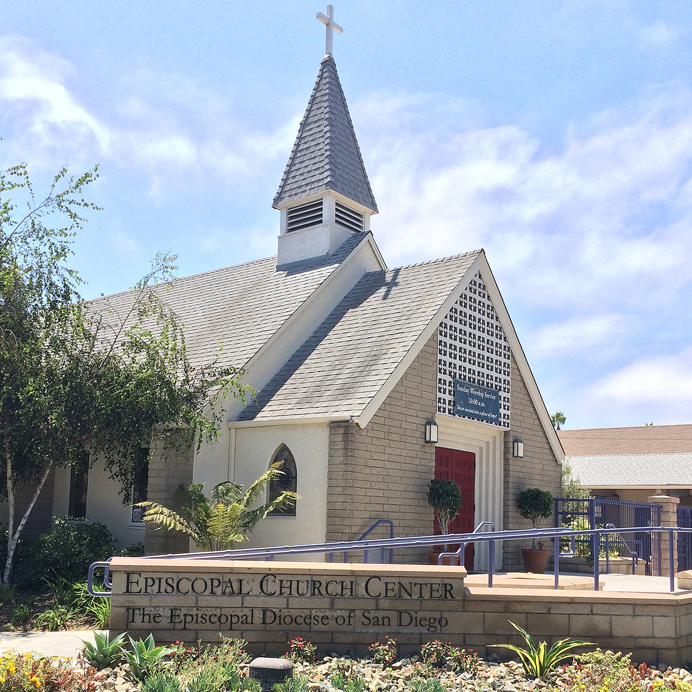
The Episcopal Church Center is located within San Diego’s Coastal Zone and the Ocean Beach Cottage Emerging Historic District. Its sanctuary was built in 1951. Preserving and restoring the unique architectural qualities was important to this congregation.
Also essential was the church’s commitment to environmental responsibility.
As part of the design, we reused a multi-faceted stained-glass window that was originally in a monastery in Palm Springs. Additionally, we restored an east window to cast light on the sanctuary floor and created a new side entry with a view into the courtyard.
This church also includes the Loaves and Fishes ministry, which supports the hungry, and a community health clinic used by California State University San Marcos. We were able to transform the first floor into a flexible space that can be used simultaneously by two different groups.
Discover more about this project here.
Designing for Two Historically Housed Churches in La Mesa, California
Our experience designing houses of worship and historic properties converged again for two churches in La Mesa, California.
A mix of uses drove our remodel design for Christ Lutheran Church. The remodel included its chancel sanctuary, multiple restrooms and the lower gym locker rooms.
Platt/Whitelaw is also conducting assessment and documentation services for La Mesa First Methodist. Like Christ Lutheran Church, La Mesa First United Methodist is also in a beautiful old building that harkens back to La Mesa’s history as one of the first cities founded in San Diego County.
Common Threads in Spiritual Design
Each design for a place of worship should be as unique as its congregants, its story and its history, but we can also count on some constants.
For all spiritual design projects, we:
- Customize the building materials used but always make sure they hold up to high traffic.
- Use lighting to direct focus and inspire a feeling of reflection but always specify energy efficient systems.
- Consider the unique symbology, rituals and traditions when creating a floor plan but always optimize it for efficiency.
Sacred space design presents unique challenges, but each uniqueness provides our inspiration. Over our decades of experience in sacred space design, we’ve learned that architecture can shape the worship experience, but the worship informs the architecture first.
A Legacy of Sacred Space Architecture
While Platt/Whitelaw has many decades of experiencing in sacred space design, one of our principals has sacred space design in his bones … or at least in his family tree.
Principal Peter Soutowood comes from a line of religious spaces architects and designers. His great grandfather founded the family firm, Albert Wood and Five Sons, which focused on church and synagogue design and art.
Each of the five sons, including Peter’s grandfather, had a different specialty in this family studio. One practiced interior architecture (his grandfather), while others tackled stained glass, wood carving, textile art and painting. They also crafted furniture, including a trunk for Amelia Earhart that is now on display at the Smithsonian.
In addition to Peter’s work carrying on the design legacy, he has a cousin who crafts and plays electric violins.
Interested readers can learn more about the family’s origin story from the New Yorker article here.